
When Anxiety Won't Budge

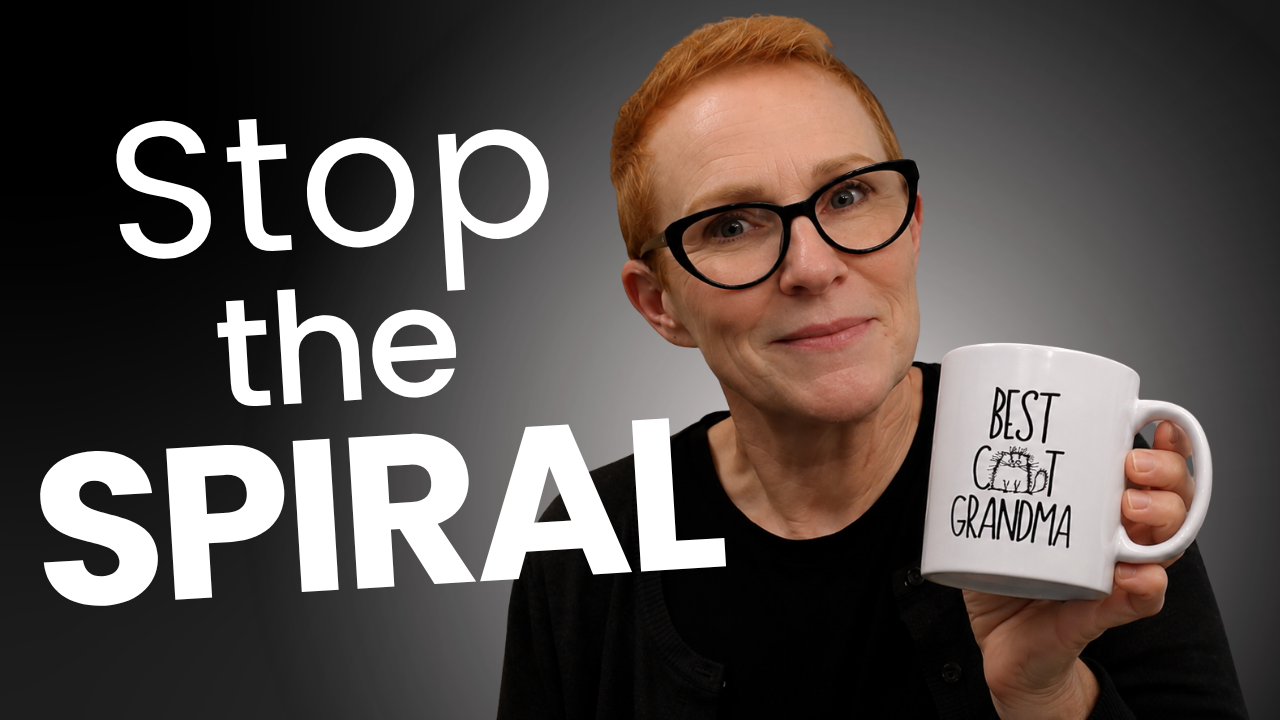
Why Tiny Embodied Actions Sometimes Help More Than Another Plan
If you're the woman who has the paperwork organized, the plans made, the boxes packed, and the lists checked off—but still wakes up at three o'clock in the morning wondering what she forgot—this conversation is for you.
Recently, I found myself caught in exactly that kind of moment.
I was preparing for another step in my move to France. On paper, everything was moving forward. The forms were completed. The documents were assembled. The plans were in motion. There was no crisis unfolding and no emergency demanding immediate attention. Yet my nervous system seemed entirely unconvinced by these facts.
My mind kept circling the same questions. Had I forgotten something important? Was there a detail I had overlooked? Was there some hidden problem waiting around the corner that I simply hadn't discovered yet?
If you've ever tackled a major life change, you may recognize this feeling. It often arrives after we've done everything we reasonably can. We've researched, prepared, organized, and double-checked. The practical work is complete, but the nervous system continues scanning the horizon for danger.
What surprised me wasn't that I became anxious. What surprised me was what eventually helped.
It wasn't another checklist.
It wasn't another hour spent researching.
It wasn't another journal entry.
It wasn't a better plan.
It was washing a coffee mug.
Now, I realize that sounds ridiculous.
Of all the dramatic stories one might tell about moving to another country, "the day a coffee mug regulated my nervous system" probably isn't high on the list. Yet standing at the sink with warm water running over my hands, slowly scrubbing a favorite mug, something shifted.
Not dramatically.
Not magically.
But enough.
Enough to lower the volume.
Enough to stop feeding the spiral.
Enough to feel perhaps fifteen percent calmer than I had a few minutes before.
That small experience reminded me of something I think many of us forget when we're anxious: sometimes the problem isn't a lack of information. Sometimes the problem is that we're trying to solve an activated nervous system with more thinking.
For many of us—especially those who have spent a lifetime being competent, prepared, and responsible—thinking has become our default coping strategy. We think our way through challenges. We gather information. We make plans. We anticipate problems before they arise. These skills serve us well in many areas of life.
The trouble is that thinking and regulating are not always the same thing.
There comes a point when the practical problem has already been addressed. The appointment has been scheduled. The forms have been submitted. The decision has been made. Yet the nervous system remains activated, as though there is still an immediate threat requiring action.
When that happens, more thinking doesn't necessarily create more safety. Sometimes it simply sends us around the same mental loop again and again.
This is where embodied activities can be surprisingly helpful.
An embodied activity is simply something that brings us back into our lived physical experience. Rather than existing entirely in our thoughts, we reconnect with movement, sensation, rhythm, and the present moment. These activities don't need to be impressive. In fact, the more ordinary they are, the better.
Washing dishes. Folding laundry. Watering plants. Walking the dog. Sweeping the floor. Kneading bread. Stretching. Gardening.
The value isn't found in productivity. It's found in participation.
Standing at the sink that day, I wasn't consciously trying to calm myself down. I was simply washing a mug. Yet the experience was surprisingly rich with sensory information. There was the warmth of the water, the scent of the soap, the familiar weight of the ceramic in my hands, and the repetitive movement of the dish brush. Without realizing it, my attention had shifted away from an imagined future and back toward the reality of the present moment.
This matters because anxiety often pulls us into futures that do not yet exist. Our minds race ahead, trying to anticipate every possible outcome. The body, meanwhile, responds as though those imagined scenarios are happening right now.
Embodied activities gently interrupt that process. They give the nervous system something concrete to experience. Instead of rehearsing future catastrophes, we begin noticing what is actually happening in the room around us.
There is another reason these activities can be so powerful, and it may be the most important one of all: they create completion.
Many of the situations that trigger anxiety have no clear ending. Waiting for medical results doesn't have a satisfying conclusion until the results arrive. A visa application remains unresolved until the decision is made. Major life transitions unfold over weeks, months, and sometimes years. The nervous system can become exhausted trying to live inside so much uncertainty.
A dirty mug, however, has a beginning, a middle, and an end.
You start.
You wash.
You finish.
That tiny cycle of completion may seem insignificant, but it offers the nervous system something uncertainty cannot provide. It creates a sense of movement and resolution, however small.
I think this is one reason so many people find comfort in gardening, walking, knitting, baking, or even organizing a single drawer. These activities don't solve life's larger uncertainties, but they provide a small experience of completion while we wait for bigger answers to arrive.
Perhaps the most important lesson from that morning, however, was that I didn't need to feel completely better.
I think many of us secretly expect regulation to feel dramatic. We imagine that we'll suddenly become calm, confident, and certain. When that doesn't happen, we assume whatever we're doing isn't working.
But that's not what happened for me.
I didn't become fearless.
I didn't suddenly know everything would work out.
I didn't stop caring about the outcome.
I simply felt about fifteen percent calmer.
And sometimes fifteen percent is enough.
Enough to breathe more deeply.
Enough to stop catastrophizing.
Enough to recognize that nothing is actually wrong in this moment.
Enough to decide whether there is truly another action to take—or whether the next step is simply waiting.
That distinction has become increasingly important to me during this season of reinvention. Not every uncomfortable feeling requires a solution. Not every anxious thought requires an answer. Sometimes what we need most is not another plan, but another way of being present while uncertainty unfolds.
If you're the woman who has done everything she can think of and still finds herself lying awake wondering whether she missed something important, I hope this offers a little reassurance.
You may not need another checklist.
You may not need another hour of research.
You may not need another attempt to think your way to certainty.
You may simply need something embodied.
A walk.
A garden.
A cup of tea.
A basket of laundry.
A favorite coffee mug waiting in the sink.
The next helpful step may be much smaller than you think.
And sometimes that's enough.
Continue the Conversation
If this idea resonated with you, you may also enjoy my companion article:
Take Your Brain for a Walk: From Chaos to Clarity
In that piece, I explore why walking is one of my favorite forms of moving meditation, how movement helps untangle complicated thoughts, and why some of our clearest insights arrive when we stop trying so hard to force them.
Because sometimes the answer doesn't arrive while sitting at a desk.
Sometimes it arrives halfway down a trail while your dog conducts a very serious investigation into a patch of grass.
👉 Read Take Your Brain for a Walk: From Chaos to Clarity here: [Insert Link]
And if you'd like more companion essays, reflections from life in France, trauma-informed insights, and occasional updates from Ralph, you can subscribe to the Ralph's Tales newsletter for free.