
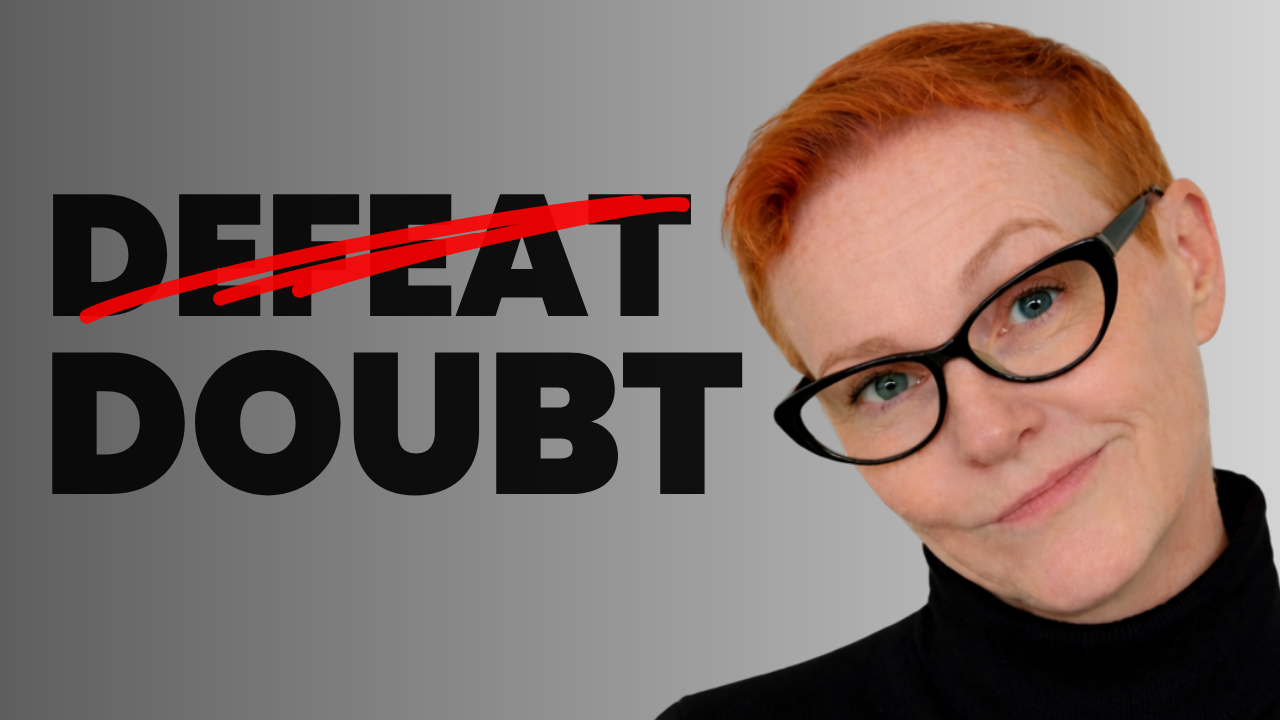
What If You’re Not Supposed to Overcome Self-Doubt?

There’s a particular kind of waiting that can stretch on for years without ever announcing itself.
It often sounds reasonable. Responsible, even. We tell ourselves we’re waiting for clarity, that we’ll move once things feel clear, once we feel sure, once the decision settles in a way that feels solid and unquestionable. On the surface, it looks like patience. It can even feel like wisdom.
But if you stay with that pattern long enough, something quieter begins to emerge. The moment you’ve been waiting for—the one where everything feels resolved and certain—doesn’t quite arrive. Not fully. Not in the way you imagined it would.
For a long time, I thought I was simply being careful. That I hadn’t reached the point yet where I could trust myself to move forward. But underneath that, there was a quieter rule shaping everything: before you change direction, before you trust yourself publicly, before you risk destabilizing your life, you should feel certain.
Certain it will work. Certain you won’t regret it. Certain you won’t blow everything up.
Without ever consciously choosing it, I had internalized the idea that doubt was a problem to solve before I was allowed to act. Something to outgrow. Something to eliminate. Something that needed to disappear before I could trust myself.
So every time a flicker of doubt appeared, I treated it like a signal to stop.
When Doubt Is Misunderstood
If you’ve ever felt frozen in the face of a big decision, it probably didn’t feel abstract or philosophical. It likely felt immediate and physical—like your body was scanning for danger, trying to anticipate outcomes, bracing for impact before anything had even happened.
That response makes sense, especially if the unknown hasn’t always been kind to you. When unpredictability, instability, or emotional whiplash are part of your history, the nervous system learns something deeply practical: unknown can mean unsafe.
And when something registers as unsafe, the body doesn’t pause to analyze. It mobilizes. It scans, predicts, and attempts to prevent harm before it occurs.
In that context, the desire for certainty isn’t a flaw. It’s adaptation. Of course certainty feels like safety. Of course you want to feel sure. There is nothing broken about that response—it’s your system doing exactly what it learned to do.
The Part That Doesn’t Work
What took me a long time to notice is that certainty isn’t something I can reliably generate. And it isn’t something life reliably provides.
Even on the days when something feels aligned, when a decision feels meaningful or right in a deeper, quieter way, there is still a wobble. A thin thread of “what if” that doesn’t fully disappear.
For years, I interpreted that wobble as a stop sign. As evidence that I wasn’t ready yet, that something needed to resolve before I could move.
Now I’m beginning to see it differently.
Not as something to eliminate, but as something to relate to in a different way.
A Different Definition of Readiness
We tend to define readiness as the absence of doubt. But what if readiness has less to do with eliminating doubt and more to do with how we relate to it?
That shift is subtle, but it changes the entire equation. Because if readiness isn’t about certainty, then it isn’t about waiting to feel different before you act. It’s about developing the ability to stay present, even when doubt is there.
It’s about capacity.
What Capacity Feels Like
Capacity feels different in the body than certainty does. Certainty is tight. It wants guarantees and predictability. It wants everything resolved in advance.
Capacity, on the other hand, feels more spacious. It doesn’t remove discomfort, but it changes your relationship to it. It sounds like a quiet internal acknowledgment: I can handle this. I can tolerate not knowing. I can respond if something unexpected happens.
Certainty is oriented toward prediction. Capacity is oriented toward response. And those are fundamentally different nervous system postures.
When we chase certainty, we’re trying to eliminate risk. When we build capacity, we’re increasing our ability to meet whatever arises.
It’s quieter work. But it’s also more stable.
What It Looks Like in Real Life
Capacity doesn’t show up as a dramatic transformation. It shows up in small, often ordinary moments.
It looks like making a phone call even though your voice shakes, or having a hard conversation and trusting that you can survive the discomfort that comes with it. It looks like being able to say, “I don’t know yet,” without collapsing into shame or self-judgment.
It doesn’t mean you feel calm. It means you’re not entirely ruled by the surge of activation when it comes. Your nervous system can react—and you can still remain present enough to stay with yourself.
That’s not bravado, and it isn’t forcing yourself through something. It’s something quieter and more sustainable.
It’s regulated persistence.
How Capacity Actually Grows
One of the most surprising things about this process is how incremental it is. Capacity isn’t built through dramatic leaps or sweeping changes. It grows through what I’ve come to think of as tolerable stretches.
Small moments where you stay just a little longer than you used to. Where discomfort appears, and instead of immediately withdrawing, you remain present for a few extra seconds. Where uncertainty exists, and you don’t demand that it resolve itself right away.
These moments are easy to overlook because they don’t feel significant. Pausing before reacting. Allowing yourself to feel nervous without deciding it means something is wrong. Moving forward gently instead of dramatically.
They don’t feel like breakthroughs.
But over time, they accumulate.
Your window of tolerance widens. The wobble doesn’t disappear, but it no longer has the same power to knock you over.
Why This Matters for Reinvention
This shift isn’t just internal. It directly shapes what we allow ourselves to do.
If you’re waiting to feel completely certain before making a meaningful change, you may find yourself waiting indefinitely. Life doesn’t offer guarantees, but it does offer opportunities to expand capacity.
And capacity makes uncertainty workable.
Not comfortable. Not glamorous. But workable.
And workable is enough to begin.
A Different Way Forward
Reinvention isn’t about becoming fearless. It’s about becoming steady enough to move while fear is present. It’s not about eliminating ambiguity, but about strengthening the part of you that can hold it.
That kind of steadiness doesn’t arrive all at once. It builds gradually, one small, regulated stretch at a time.
If there’s an area of your life where you’ve been waiting to feel more certain, you don’t have to change anything today. But you might notice what happens when you shift the question.
What changes if the goal isn’t certainty, but capacity?
Pay attention to what happens in your body when you consider that. There’s no right response—only information.
If you’d like to sit with this more quietly, the companion reflections are available by email, where each piece arrives at a slower pace. Just boop the Subscribe button on this page.
And if you’re not quite finished with this idea yet, there’s a video that continues the conversation in a slightly different way.
No urgency.
Just one regulated step at a time.
Ralph, for what it’s worth, continues to demonstrate an almost limitless capacity for receiving positive feedback. I’ll make sure he knows if you said hello.
A bientôt, mes amis.
À la prochaine fois.
Rondi et Ralph 🐾