
What Happens When Your Reality Gets Twisted

It usually starts quietly.
Not with something you can easily name.
More like a thought that slips in sideways:
Maybe I’m overreacting.
Maybe I’m too sensitive.
Maybe I misunderstood.
And so you do what thoughtful, conscientious people do.
You replay the conversation.
You soften your tone.
You try to explain yourself more clearly… more calmly.
But something doesn’t settle.
In fact, the more you try to stay reasonable…
the less stable things begin to feel.
This Is Where Gaslighting Begins
Gaslighting doesn’t usually arrive as one obvious lie.
It shows up as a pattern.
Details get denied.
Words get reframed.
Context gets shifted.
And slowly—very slowly—the focus moves.
Away from what actually happened…
…and onto you.
Your tone.
Your reaction.
Your interpretation.
And that shift matters.
Because once the focus is on you—
your perception becomes the thing under question.
The “Crazy-Making” Feeling
There’s a reason people use that phrase.
Because this experience doesn’t just create disagreement.
It creates disorientation.
You’re holding something that felt real.
Something you saw.
Something you heard.
And at the same time…
you’re being told that it didn’t happen that way.
Or didn’t happen at all.
Or that your reaction is the real issue.
Those two realities don’t fit together.
And your nervous system feels that mismatch.
That’s the tension.
That’s the strain.
That’s the beginning of the “am I losing it?” feeling.
That Doubt Is Not Random
At some point, the questions turn inward:
What if I’m the unstable one?
What if I’m the narcissist?
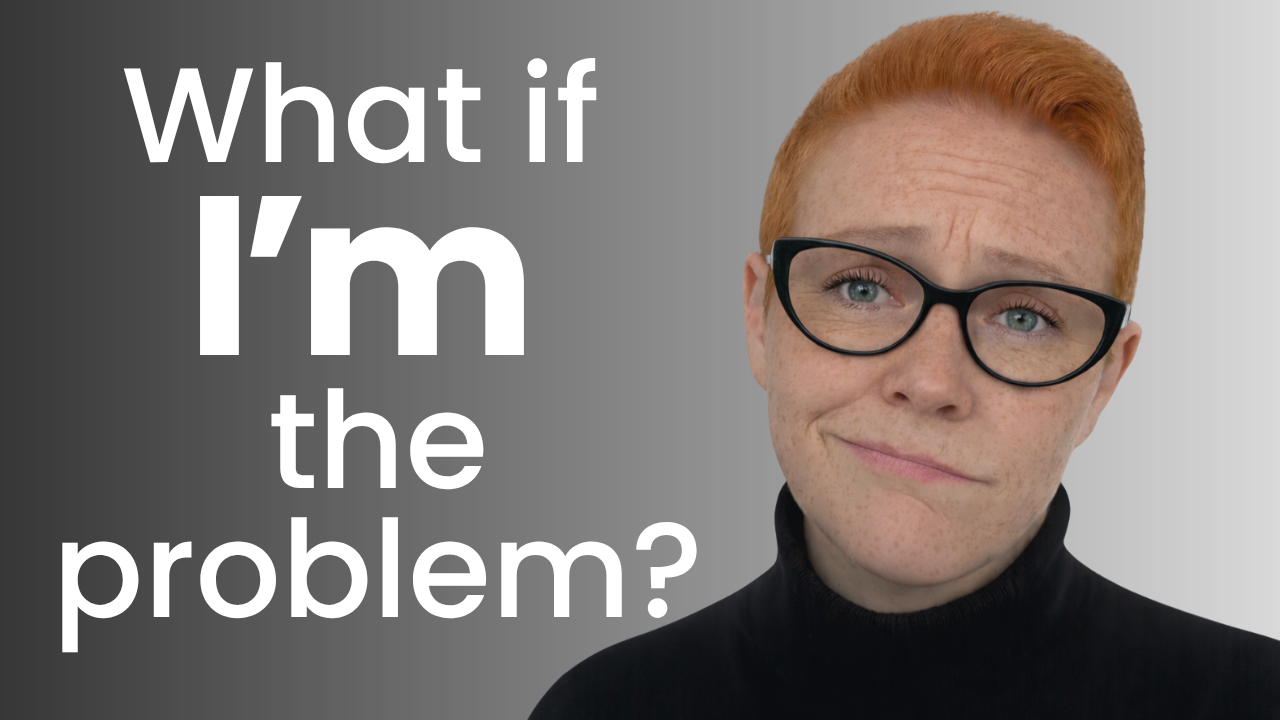
What if I’ve been the problem all along?
That kind of doubt feels deeply personal.
But it doesn’t appear out of nowhere.
It’s built.
Layer by layer.
Through repeated contradiction, denial, and reframing.
Gaslighting Is About Control
This is the part that often gets softened—but it matters.
Gaslighting is not just miscommunication.
It is a way of wielding power.
Because when someone can destabilize your sense of reality…
when they can create doubt in your own perception…
when they can fracture your self-trust…
they don’t have to control you directly anymore.
You begin to self-correct.
Self-silence.
Self-doubt.
The control moves inside.
How the Dynamic Tightens
There’s a pattern that shows up again and again.
Something happens.
It’s denied.
You try to clarify.
You’re told you’re wrong.
Then it happens again.
And again.
Until eventually, your nervous system reacts.
And when it does—
your reaction becomes the story.
Not what happened.
Not what was said.
Not what was denied.
Just your reaction.
And now the focus is firmly on you.
Disorientation Is the Goal
This part is important enough to name clearly:
The confusion is not a side effect.
It’s the point.
Because when you are disoriented…
you are easier to influence.
Easier to redirect.
Easier to control.
And if that disorientation lasts long enough—
you begin to lose access to your own internal compass.
The Compass and the Magnet
You have an internal sense of knowing.
A quiet one.
The part of you that registers:
That felt off.
That’s not right.
Yes… that’s true.
Gaslighting works by introducing interference.
Like a magnet placed near a compass.
The compass isn’t broken.
But it stops pointing cleanly.
And after a while…
you don’t realize there’s interference.
You assume the problem is you.
The Role of Introspection
This is where something very human gets used against you.
If you are someone who reflects…
who questions yourself…
who wants to be honest and accountable…
you are more likely to turn inward when something feels off.
That introspection is a strength.
But in a gaslighting dynamic—
it becomes part of the “crazy-making.”
Because instead of using your reflection to understand reality…
you start using it to doubt reality.
To override your own perception.
To give the benefit of the doubt—again and again—
even when something isn’t lining up.
About That Question
“What if I’m the narcissist?”
I want to pause here.
Because this question often appears right at the point
where self-trust has been most deeply shaken.
And I’ll say this carefully.
That question—asked with genuine concern, reflection, and honesty—
is not how narcissism typically presents.
But it is what happens when someone’s internal compass
has been interfered with long enough.
This Isn’t Just Personal
Gaslighting doesn’t only happen in intimate relationships.
It can show up anywhere power meets narrative:
Families.
Workplaces.
Institutions.
Media.
Governments.
Anywhere reality can be reframed…
denied…
or rewritten loudly enough…
people can be made to question what they are seeing in real time.
And again—
the body doesn’t register that as “debate.”
It registers it as instability.
Reinvention Requires Orientation
This is where this connects to something deeper.
Reinvention isn’t just about change.
It’s about orientation.
Because you cannot build a life you trust
using a compass you don’t trust.
And when gaslighting has eroded that trust—
everything can feel unsteady.
Not because you are unstable.
But because your reference point has been repeatedly disrupted.
Finding Your Way Back
We don’t need to turn this into a project.
But there are small ways to begin reconnecting.
You might notice how quickly your mind goes to:
It’s me.
Just notice the speed.
You might pause before apologizing.
Not to withhold repair—
just to ask:
Am I actually wrong…
or am I trying to stabilize something outside of me?
You might write things down as you experienced them.
Not to prove anything.
But to stay connected to your own perception.
And you might remember—
when the interference is removed…
the compass steadies.
Not instantly.
But gradually.
Ralph, Naturally
Ralph has never once questioned his reality.
He is very clear on what is true.
Especially when it involves snacks.
There’s something regulating about that.
Not the certainty that dismisses others—
but the kind that stays anchored in the body.
Uncomplicated.
Direct.
Intact.
One Quiet Truth
Gaslighting can train someone out of self-trust.
Through repetition.
Through contradiction.
Through disorientation.
But that also means…
self-trust can be rebuilt.
Not all at once.
Not perfectly.
But one small, north-pointing moment at a time.
If This Feels Familiar
If you’ve been carrying thoughts like:
Maybe I imagined it.
Maybe I’m too sensitive.
What if I’m the problem?
I want to offer this gently:
Those thoughts may not be evidence that something is wrong with you.
They may be evidence that something has been
working to disconnect you from your own knowing.
We don’t have to resolve everything today.
But we can begin—
slowly—
to notice what still feels true.
If reading feels like the steadier place to sit with this, you’re already here.
And if you want to hear it spoken, the video holds it in a different way.
Either way…you don’t have to untangle this all at once.
We can keep orienting. Together.
A bientôt,
Rondi & Ralph 🐾